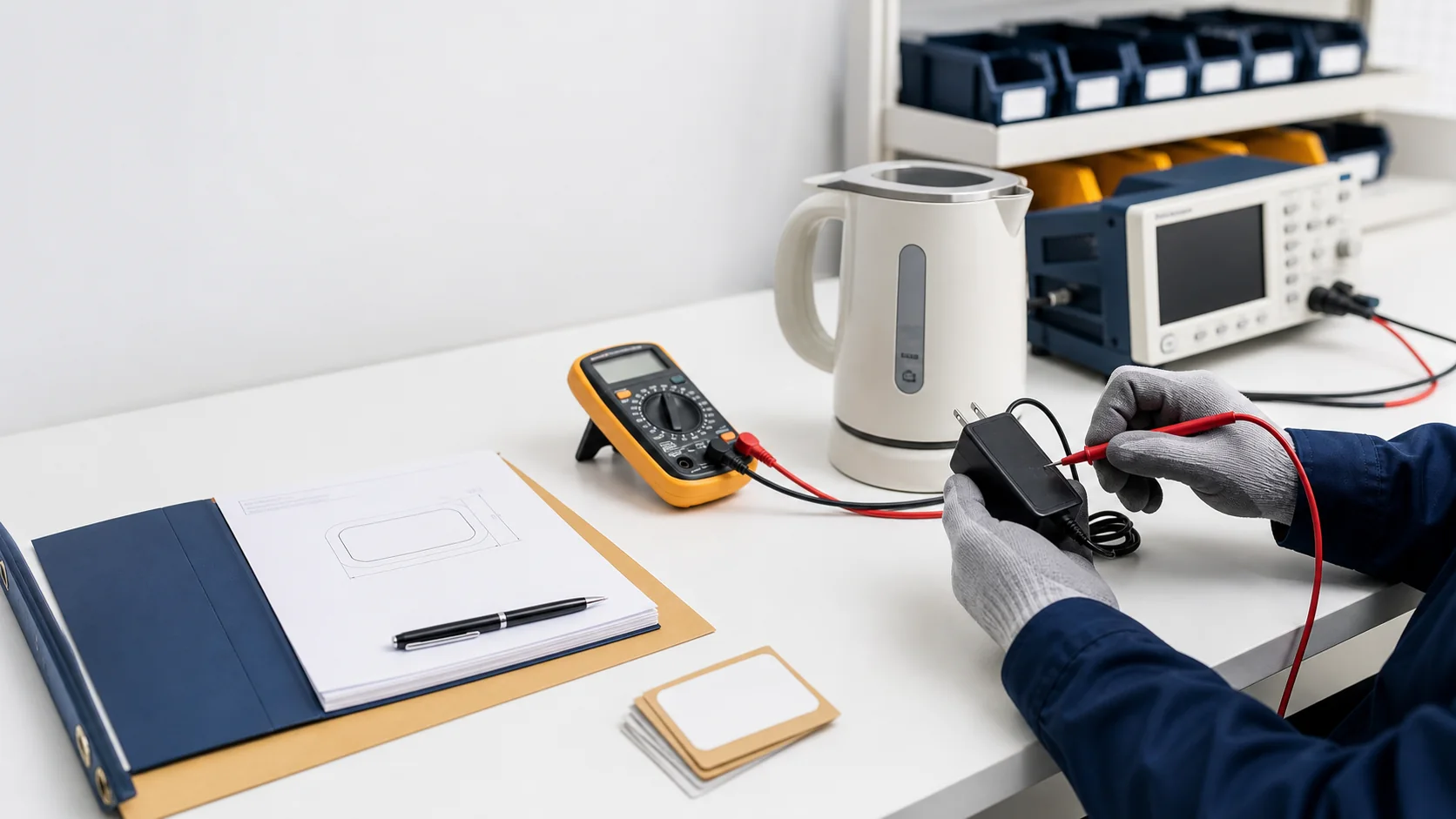
What is EESS (Electrical Equipment Safety System)?
The Electrical Equipment Safety System (EESS) is Australia’s harmonised equipment safety framework for in-scope electrical equipment. It ties products to a registered Responsible Supplier in Australia, assigns equipment to risk levels (Levels 1, 2, and 3), and requires national database registration and— for higher-risk equipment—certification from an approved certification body where the rules mandate it.
States and territories enforce electrical safety law with local nuance, but EESS gives importers a single coherent storyline for equipment registration and market surveillance traceability. If your SKU set spans multiple voltage accessories or modular battery systems, treat the database as the system of record for model numbers, certificate references, and variant control.
For a deeper narrative on batteries and energy storage specifically, see Energy Storage Battery Compliance: RCM, EESS and AS/NZS 5139 Explained.
What is the RCM (Regulatory Compliance Mark)?
The Regulatory Compliance Mark (RCM) is the compliance mark for electrical safety, electromagnetic compatibility (EMC), and telecommunications equipment where applicable. It signals that the supplier has met registration obligations and that equipment is declared against relevant standards—subject to correct installation and use.
RCM is not a substitute for test evidence. It is the visible output of a conformity process that includes accredited testing where required, technical files, labelling rules, and supplier declarations. Slapping an RCM without a valid compliance chain exposes directors to enforcement and creates civil liability if product failure causes damage.
Chinese factories should be given explicit artwork rules: mark size, proximity to model identifiers, and serialisation that maps to certificates—retailers reject ambiguous cartons.
Which products need EESS and RCM?
Think broadly: consumer electronics power supplies, adapters, LED luminaires, extension cords, portable tools, battery packs, chargers, and integrated battery energy storage systems commonly fall into regulated categories when they are in-scope electrical equipment under the uniform legislation and associated rules. Batteries are not “just chemistry”—they are electrical articles with hazard profiles that regulators treat seriously at import and at retail.
If you are unsure whether a product is in-scope, start with voltage, function, and intended sale environment—not with whether the factory calls it a “component.” Accessories bundled with main products still need their own evidence trail when they are separate regulated articles.
Align your programme with Australia market entry & 3PL so that inbound SKU data matches what your Responsible Supplier will register.
Ten-step compliance checklist for importers
- Determine in-scope status under the electrical equipment uniform legislation and EESS rules; document rationale for border and legal files.
- Identify applicable AS/NZS standards for electrical safety and EMC; map each variant, firmware revision, and power rating that changes the test plan.
- Commission testing at an accredited laboratory (e.g., NATA in Australia or ILAC MRA signatory overseas where accepted pathways apply) and close nonconformities before mass production.
- Obtain a Certificate of Conformity where Level 3 (or applicable Level 2) equipment requires certification; maintain certificate currency across factory changes.
- Register as a Responsible Supplier with the relevant state electrical safety regulator and complete national database steps for each registered model.
- Apply the RCM mark to the product and packaging per marking rules; align serial numbers with the technical file and database entries.
- Maintain a technical file including test reports, declarations, risk assessments, and change logs accessible for surveillance audits.
- Submit annual compliance declarations where required; calendar this with finance—missed declarations can break continuity of supply.
- Prepare for border inspections: consistent model descriptions, HS alignment, certificates, and dangerous goods paperwork for lithium shipments where applicable.
- Operate post-market surveillance: incident response, firmware update governance, and retailer recall readiness coordinated with your Australian sponsor.
Energy storage: AS/NZS 5139 and UN 38.3
Battery energy storage introduces AS/NZS 5139 installation expectations that shape product design evidence—clearances, mass handling, communication interfaces, and installer documentation. Separately, UN 38.3 transport testing underpins lithium cell and battery movement by air and sea; without credible test summaries aligned to the shipped configuration, forwarders will block bookings.
Treat installation and transport as parallel compliance streams that share a single engineering truth in your PLM system.
State rebate programmes and why compliance unlocks them
Household battery incentives in Victoria, South Australia, Queensland, and related programmes elsewhere often reference approved product lists and installer networks. Hardware that is not properly listed, certified, and traceable will not enter those commercial pathways—even if it clears customs once.
For a 2026-oriented importer summary of rebates and CEC listing context, read Home Battery Rebate Programs 2026: State-by-State Guide for Importers.
Common border rejection reasons
Mismatched model numbers between test reports and shipment invoices; missing or expired certificates; incorrect Level assignment; EMC retest gaps after firmware updates; lithium batteries declared with wrong state of charge or packaging instruction; and “gift bundle” accessory lines without standalone compliance files.
Pre-shipment document matching—line by line against the packing list—prevents expensive demurrage stories.
NATA, ILAC, and why your test report is a commercial asset
Australian conformity assessment pathways expect credible laboratory outputs. NATA accreditation is the domestic gold standard; overseas testing under ILAC mutual recognition arrangements can be acceptable where rules permit, but importers should confirm acceptance with their certification body and Responsible Supplier counsel before they spend six figures retesting unnecessarily—or, worse, skip retesting when a retest is actually required.
High-quality reports include clear product identification photos, explicit standard editions, instrument calibration references, and pass/fail tables that a non-laboratory reviewer can audit in under thirty minutes. Low-quality reports invite questions: vague product descriptions, missing EMC plots, or firmware versions that do not match the BOM shipped. Treat the report as a sales-facing document to installers and insurers, not only as a regulatory checkbox.
EMC deserves special mention for products with switching power supplies, wireless modules, or motor drives. A product electrically “safe” in isolation can still fail EMC and be refused registration or be subject to market withdrawal if interference complaints arise. Plan EMC retests whenever you change clock speeds, shielding, grounding topology, or cable harness lengths.
Battery importers should also align BMS firmware version strings across the test report, the user manual, and the software update server—surveillance teams notice drift quickly.
EESS risk levels and procurement discipline
Equipment Levels 1, 2, and 3 are not marketing badges—they determine whether self-declaration suffices or whether an approved certificate is mandatory. Procurement teams should translate level decisions into purchase order gates: no shipment without certificate coverage for the exact factory line, no “equivalent component” swaps without engineering sign-off, and no parallel grey-market supplier feeding the same SKU code.
Distributors sometimes attempt to aggregate multiple overseas factories under one brand umbrella without separate technical files. That strategy collapses the first time a state regulator compares serial ranges against certificate scope. If you must dual-source, dual-file: maintain explicit mapping from serial prefixes to manufacturing sites and test evidence.
Training matters: sales teams should not invent compliance stories on calls. Provide them with a one-page “approved claims” sheet tied to database entries so that retailer RFP responses stay within evidence.
Post-market surveillance in Australia is real—random sampling, incident-driven investigations, and competitor complaints all occur. A disciplined technical file turns an investigation into a boring paperwork exercise instead of a stop-sale event.
Retail, Amazon, and why listing compliance is not “optional branding”
Major marketplaces and national retailers run automated and manual checks against declared model numbers, RCM presence, and certificate metadata. A common failure pattern is uploading a US FCC ID or a CE declaration of conformity where Australian rules expect a different evidence stack. Even when a listing temporarily goes live, competitor complaints or marketplace sweeps can remove SKUs during peak season—exactly when marketing spend is committed.
Build a retailer-ready pack: high-resolution label photos, certificate PDFs with highlighted scopes, a one-page EMC summary, and a contact tree for engineering escalations. Australian buyers respect suppliers who answer technical questions in the same week, not after the next Canton Fair.
If you operate hybrid models—D2C plus wholesale—keep a single source of truth for which entity holds Responsible Supplier registration to avoid contradictory declarations across channels.
Timeline and costs (planning view)
First-time electrical programmes typically span multiple quarters when retests and factory remediation appear. Budget for testing, certification, legal entity costs for Responsible Supplier registration, label rework, and technical file maintenance—not only unit COGS.
Experienced teams compress schedules by freezing variants early and refusing silent BOM changes mid-certification. They also budget for “Australia packaging” lines that differ from domestic Chinese retail cartons—RCM proximity rules, bilingual warnings, and serialisation blocks are not afterthoughts.
Hidden costs include failed factory audits that require second visits, expedited retests when a retailer launch date slips, and legal review when a competitor challenges your database entry. A conservative programme adds contingency for one full retest cycle per flagship SKU family in year one.
Finally, connect compliance spend to channel pricing: premium retailers and national installers will pay for certainty—document that value in your channel business case rather than treating compliance purely as overhead.
How XYX helps
XYX Holdings coordinates sourcing, documentation, and market entry so that your compliance programme is executable in both countries. We align factory deliverables with Australian registration milestones and connect you with laboratories and certifiers appropriate to your equipment class.
Start a conversation via contact with your SKU list and target channel—retail, installer-direct, or e-commerce—and we will propose a sequenced plan.
Electrical compliance done well is a moat: it protects users, unlocks premium channels, and makes your brand legible to Australian partners.